|
In
the last 33 years Verlen Kruger has paddled 88,000 miles, several times
farther than anyone else has paddled in the history of the world. In one
trip he paddled down the Mississippi in 23 days, breaking the current
record almost in half. In another he went 21,000 miles from the edge
of the Arctic to the verge of the Antarctic. In another he paddled and portaged 28,000 miles across North America. Last
June, Kruger turned 75. But that's not slowing him down one
bit. In fact, he is on pace to log 100,000 miles by the time he
turns 80 , and to surpass 150,000 miles by age 100. "All
things," he says, "are possible with God."
|

Kruger is the world's premier long-distance canoeist.
There's none better. And in honor of that, the American
Canoe Association has inducted him into its Hall of Fame. |
If anything he is looking even
spryer these days. For good reason. In June, he got down on
his knee -- just like he had during his countless miles of canoeing -- and
re-married Jenny Kruger, whom he married in 1945 and then was divorced
from 12 years ago. His nine children, all from Jenny, were present
to witness the vows. "June was a big month for me," says
Kruger with a twinkle in his eye. "I'm happier than
ever." His happiness was further established in September when
his peers recognized his contributions to the paddling world by bestowing
him with the American Canoe Association's Legend of Paddling award.
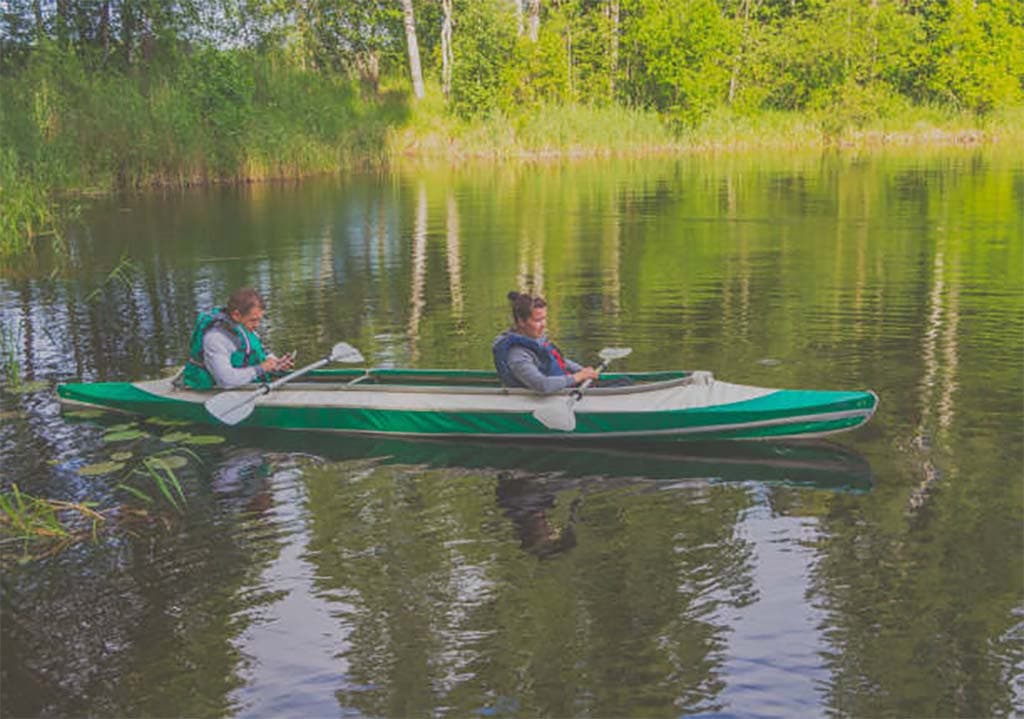
It's winter in Michigan, and
Kruger, who built all the boats he has taken on his adventures, proposes
paddling up the Grand River that runs by his home. He throws a tarp
off a couple of Sea Winds and tells me to drag them down to the
river. He doesn't like to scratch the boats, but if it comes to that
or wasting energy or getting wet, the boats get scratched. These two
are scratched profusely, having been dragged down rocky trails and dashed
against rocky coasts, and they aren't even bothered. They slide down
the bank, drop into the river and are instantly upright. Their equilibrium
appears so steadfast it's as if they have imaginary deep keels.
The Sea Wind, with a paddlers
weight on the tractor seats, is amazingly stable -- try heeling it over
and it surges back with redoubled resilience, as if powered by hydraulics.
Without the rudder it is confounding to maneuver, like steering a
haystack. With the rudder, it is guided by wishes alone.
"That's what the hull and rudder are all about," Kruger says as
we paddle away from shore. "I've tried V-bottoms, round
bottoms, sharp ends, square sterns. I guess this hull is what you
would call a shallow arc -- a circle sort of flattened out to where
there's not much the water can get a hold of. The catch is that the
hull doesn't really get a hold of the water, so the boat wanders.
But I solved that with the rudder, which is the most efficient thing you
can have in a canoe."
His stroke is so efficient that
nothing can possibly stop him, and his boats move so efficiently that
nobody would want them to stop. The Grand River is the longest in
Michigan. He often has paddled its length and now appears committed
to do so again, just for having launched. "The last long trip
ended in '89, when we reached Cape Horn," he says. "But
every year we still do some trips of a couple hundred miles or more.
Like from Chicago to New York three years ago, or two years ago around
lower Michigan, which was a thousand miles. I'm looking for sponsors
for one more long trip -- Paddle to the Sea, after a story in a children's
book about a small wooden carving of an Indian canoe drifting through the
Great Lakes and the St. Lawrence river to the Atlantic Ocean. Except
in the same trip I'd also like to paddle down the Mississippi, which isn't
in the book but is the other way to the sea. But my old partners
aren't tripping any more. I have to go alone."
He paddles in silence for awhile.
"Which trip was best?
Good question. Probably the most impressive was the Ultimate Canoes
Challenge when we covered North America by canoe." On that one,
he and son-in-law Steve Landick launched in Montana on April 29,
1980. They paddled the length of the Missouri River, then up the
Illinois, through the Great Lakes, through rivers and canals of the
Northeast to the Atlantic. Then they headed down the East Coast,
around the Florida Keys, along the Gulf Coast and up the
Mississippi. "At New Orleans (February 1981) we were
calculating how to get clear across North America and up into the Arctic
and turn around and get back over the mountains before freeze-up," he
says. Dipping his paddle into the water. "We figured it was a
race."
They paddled the Mississippi
upstream; that done, they paddled and portaged northwest across Canada and
came down the Mackenzie to the Arctic Ocean on Sept. 5, 1981. Then
they paddled and portaged across Alaska, portaged over the Chilkoot Pass,
and came to the Pacific Ocean near Skagway. For 11 months they
paddled down the Pacific coast, around the tip of Baja, and up the Sea of
Cortez, arriving at the mouth of the Colorado River on March 18, 1983.
"We could have ended the trip
there," Kruger says. "But we wanted to paddle home, and
the way through the mountains was to paddle up the Grand Canyon, which no
one had ever done. We came up the canyon in 24 days, which is how
long they allow people to come down. We portaged about 200 times;
sometimes we were climbing on high ledges, hanging by our fingers, the
boats slung between us. We averaged 10 miles a day. I don't
want to do that again."
They paddled and portaged north
and east, up more rapids, across the plains, and briefly revisited
Canada. They came down through Lake Superior and Lake Michigan and
paddled up the Grand River to Kruger's house. The trip ended there
on Dec. 15, 1983. In all, they paddled 27,520 miles and portaged 523
miles, completing the longest canoe trip ever, though not becoming
famous. They applied for entry to the Guinness Book of Records: the
editors didn't reply. [Editor's note: They eventually did get in the
record book.]
The only regret that he has about
the three-and-a-half year marathon is that it cost him his marriage to
Jenny. Like many paddling addicts, he admits his canoeing got in the
way of his relationship. "I was gone too long," he
says. "I went off into a different world, and it was the
biggest mistake I've ever made. If I had known what it would cost me, I
never would have done it." After the trip, Kruger married
Valerie Fons; they had met enroute, and she had paddled with him around
Baja. Later they set the record for paddling down the Mississippi,
before paddling from Arctic to Antarctic -- the second longest canoe trip
ever.
Kruger
wasn't always such a devout paddler; he didn't take it up until he was
41. Before all his paddling adventures he was a devout Christian and
prospering plumber living -- still in his same Michigan house on the Grand
River -- with his first (and current) wife, Jenny, and nine
children. He has shown more creativity building canoes than fitting
pipes together, tinkering away with hull designs until reaching perfect
combinations of strength, durability and weight.
Fathoming Kruger and his boat
building prowess is a process both abstract and deductive. He is
short in stature, strong, driven and stoic to the point of prosaic -- a
taciturn evangelist, understanding himself and everything else short of
scripture. There are obvious clues like the Bible on the kitchen
table. There are curious signs like the omniscience of his
dog. And there is evidence in his fixation on creating boats that
transcend conventional engineering and aspire to Biblical
parameters. He designs boats from insight gathered from beyond where
anyone else has ever paddled, and he builds them to go beyond where even
he will ever paddle.
After our paddle on the Grand, we
return to the shop by his house where he is finishing a hull mold, his
41st in a long evolution of designs. The mold is only subliminally
advanced beyond the one before, and its look is organic: 17 feet long, 28
inches wide and comprehensively rounded. The roundness appears
surreal and basic, which it may be, though it still had to evolve through
40 prototypes. "It's rounded like this so there's almost
nothing for waves to grab," says Kruger, running his hand on the
hull. "I'll lay up three layers of Kevlar and just be starting,
where the more usual way is to lay up 4 layers of fiberglass and be
done. Then it's like I'm tailoring. I'll put down nine more
layers of Kevlar, making each one a little narrower, and then I'll cut it
to strengthen the hull against particular stresses and impacts.
Next, I'll double over all the layers fore and aft, where I'll lay in
still more Kevlar reinforcement. When I've laid in the twelfth and
last layer -- a six-inch strip down the center -- I will have built a hull
that can be hit by everything I've ever known to hit a boat, and I can
guarantee it will go 28,000 miles without breaking. It could go
further -- I can't guess how far -- but that's the furthest I've paddled
. So far."
He tailors his decks like he does
the hulls, laying up equally potent and profound patterns of Kevlar.
With still more Kevlar he will then fuse the two, giving the boat an
ancestral shape with the soul of a committed work boat. Despite
their intrinsic grace, sheer strength dominates their presence. No
other boats look quite like them. "The difference is that the
average canoe doesn't go a thousand miles in all the lifetime of all the
people who paddle it," Kruger says, giving a boat a hard whack and
getting only a dull thud that suggests it would be as oblivious to hammer
blows. "And the difference is that I work 60 hours on each boat
where the standard for production (plastic) canoes is five hours'
labor. And when I've got all 12 layers laid up, it's seaworthy, indestructible,
efficient and comfortable. It also costs $3,000. That's
another difference."
Forward of the cockpit is a sleeve
into which the end of an aluminum spar fits like an axle; the other end
fits into a similar sleeve in another boat, and the two boats thus become
a catamaran. ("So one person can sleep while the other paddles
over long treks on high waves," Kruger says.) He also built in
a mast step and deck fittings for a sail rig. ("A working rig
that can keep the boat reaching for days or weeks.") The deck
fittings can also anchor a sun canopy. ("For days or weeks in
the jungle or on tropical seas.") Steering pedals, sliders,
cables, and rudder -- are all heavy gauge and made of metals compatibly
matched to be immune to deterioration. ("Cables and sliders are
the only things on the boat that have ever worn out, but they'll steer
5-6,000 miles before they're done in.")
He then points to the boat's
internal reinforcing trusses, which (like everything) are of many layers
of Kevlar and which likely redouble the already prodigious strength of the
boat. He calls this the seat hanger system because the trusses also
have slots that support the seat. "The system stiffens the bottom,
rim and center tremendously," he says. "It holds the boat
together even under stresses and impacts it's not even practical to build
boats for. I suspect this is one of the most clever inventions I've
ever had."
He pulls the seat from the low
slots, turns it over, and slides it into the high slots. The
inverted seat is shaped ingeniously to be an anatomically correct portaging
yoke; hoist the boat overhead, settle the yoke on the shoulders, and the
60 pounds seem lightened by half. "The best boat carrier
anywhere," Kruger says with steadfast restraint, having portaged
thousands of miles.
"I
was 41 when I first got into a canoe," Kruger says, back in his
kitchen. "Right away I was marathon canoe racing and building
my first experimental canoe. I was tripping to train for racing, and
I was racing to train for tripping. Anyone who's got a fancy for
tripping should spend a year in the racing circuit. Racing is where
you can learn efficiency and enjoyment."
These are the axioms -- efficiency
and enjoyment. He quotes them like ethics, drills them like
catechisms. Efficiency and enjoyment are the absolutes of global
canoeing: nothing more and nothing less will go the distance.
"The Fur Trade Route was the first big trip," he says.
"It wasn't nearly as long as later trips, but it was 7,000 miles --
paddling from Montreal across Canada and Alaska to the mouth of the Yukon
at the Bering Sea. Clint Waddell was my partner; I'd learned racing
from him. We did the trip in one season where others had taken two
years; it also was the first time we did what hadn't been done
before. That was because we had better boats, for one thing, and
because we were comfortable in them. You have only so much energy to
paddle 12 to 24 hours, and if you're not comfortable you'll lose energy
you didn't even know about. Your skill takes you only as far as your
energy sustains you, and how far you go depends on how efficiently you use
the energy you have. So comfort translates into energy which
translates into efficiency, which is how you paddle 7,000 miles."
He hesitates as if unsure his
logic is sinking in. "If you don't have comfort, you give up
the trip for lack of enjoyment before you give out for loss of
energy," he adds. "You've been uncomfortable for the last
10 miles, and you realize that you have 7,000 more, and that's when all
the fun goes out of it, along with strength, resolve, efficiency, morale,
and everything else that was supposed to get you through the Fur Trade
Route. A lot of demoralized canoe trippers don't make it for a lot
of reasons that ultimately have to do with not enjoying it because they
aren't comfortable."
His boats are comfortable.
Having fixated on making them practically indestructible over tens of
thousands of miles, he now becomes obsessed with making them virtually
painless to the limits of human endurance. He makes them so
easy-riding that even as performance boats they must go long distances to
generate their sublime sense of excitement -- bearing trippers in tractor
seats which he has refined over tens of thousands of miles (and which, he
says, have never chafed his rump, nor that of any partner, on long
trips). "Tripping boats are performance boats," he
says. "But not the kind for extreme velocity and precarious
balance and surfing, rolling, and giving athletes the proverbial
rush. Even athletes who I hold in awe would sacrifice too much
energy to speed, balance, and excitement. Tripping boats are
performance boats because your effort gets you the most paddling over the
longest distance for the least pain, which means you dedicate all your
strength and boating skills to paddling forward, and you just keep going
and going. You don't use energy steering with the paddle because you
steer with the rudder, which is the next best thing to having a
partner. After half a day you'll overtake the athletes who took off
ahead of you."
He pauses again as unspoken wisdom
gathers weight and invokes the moral of the hare and the tortoise
fable. "I was heading up the Mississippi when I read that a
British Royal Air Force team had just paddled down in 42 days." he
says. "They had tandem Olympic sprint kayaks, and they beat the
previous record by three days. I thought their record could be beat,
and I got around to it when I was XX . Valerie (Kruger's second
wife) and I fit out our cruiser canoe -- 18 feet long, 32 inches wide, 80
pounds -- a performance boat fixed up like a Conestoga wagon. We
went the length of the Mississippi in 23 days: 2,348 miles paddling 18
hours a day, paddling and sleeping in shifts at night. On one haul
we paddled 24 hours straight over 160 miles. We never got out of the
boat except to portage around 11 dams; so an old man and a woman beat the
Royal Air Force by 19 days. We had figured on beating them by 12
days or more, but that was stretching it."
| "If the Dreamcatcher has to be a kayak, then
in my opinion it's probably the best ocean going larger-than-life
sea kayak ever built. And that's because of the ways it's like a
canoe, which is the most efficient vehicle ever yet invented by
man." |
The 18-foot cruising canoe was the
first tripping boat he developed through the course of conceiving,
experimenting, designing and reworking until he had it right and
pronounced it the Kruger Cruiser. It was a high-performance,
high-capacity tripping boat (though until it overtook faster boats, it
could have been mistaken for just a big canoe a plumber would
invent). He scaled down the design and made a solo canoe because
canoe trippers are a breed so rare that they must reckon on paddling vast distances
alone. He capsized his first production solo on the Pacific
Ocean. He was nearly lost but came back and built a revised solo
with more volume aft and called it the Monarch. Then he refined it
further and called it Sea Wind; and he never capsized again.
Then he put a full deck over a Sea Wind hull and created a canoe in the
image of a born-again sea kayak which he named Dreamcatcher and paddled
across a hemisphere -- though he disdained kayaks as impractical for
reasons having to do with nobody ever paddling one across a continent.
"In a kayak you're too
cramped, too wet, too low, and you're hoisting twice as much paddle,"
he says. "Figure that every ounce in your paddle adds up to
lifting one ton in a big day, and if you've got a double-bladed kayak
paddle you lift roughly twice the tonnage of a single-bladed canoe paddle,
or maybe 30 extra tons raising up the other blade. And you're down
low and have to raise your arms higher, which means you're lifting still
more tons, and you're bound to stop enjoying this before you go far at
all.
"If the Dreamcatcher has to
be a kayak, then in my opinion it's probably the best ocean going
larger-than-life sea kayak ever built," Kruger says. "And
that's because of the ways it's like a canoe, which is the most efficient
vehicle ever yet invented by man. You paddle it high and dry, like a
canoe -- with a single blade if you mean to go any distance -- and you and
the boat become so comfortable and competent together that you paddle
efficiently for 16 hours, for weeks, and you enjoy it all the way.
Valerie and I paddled two Dreamcatchers from the Arctic to Cape
Horn," he says. "We went the length of two continents,
from Canada's north coast to the tip of South America: 21,246 miles over
nearly three years, 16 million paddle strokes from the top to the bottom
of the world. (The Amazon jungle was neither as hot nor as buggy as
many other places I've been.) We crashed in the surf off Argentina,
but even there we didn't really upset; it was just that Valerie's boat
capsized after she was thrown out. We got ourselves and our gear
back together and had enough to like about the trip for the rest of the
way to Cape Horn."
As well as planning a water
quality monitoring trip on the Grand River in the year 2000, mimicking one
he did in 1990, Kruger now spends his time building boats, planning trips,
soliciting sponsors and counseling aspiring adventurers who seek him out
to serve apprenticeships in canoe tripping. "They all come
around," he says, the Grand River barely visible in the
background. "There are a lot of people with dreams of long
canoe trips. Some of them begin their trips. Some of those
finish. Sometimes I think I know which ones might make it.
Occasionally I'm right."
|